What “Somatic Studies” Is
The term “somatic” was coined by Thomas Hanna, an existential phenomenological philosopher, in the early 1970s. Although many of the approaches now considered ‘somatic’ predate this term by several decades, they share a common focus:
working with the lived, subjective experience of the body.
From a somatic perspective, body experience is always understood holistically, as part of a larger context in which that experience becomes meaningful. For example, a particular sensation or body movement may be considered in relation to the psyche, to physical health, to interpersonal and interspecies relationships, to natural or constructed physical environments, to social and cultural contexts, and to spiritual domains.
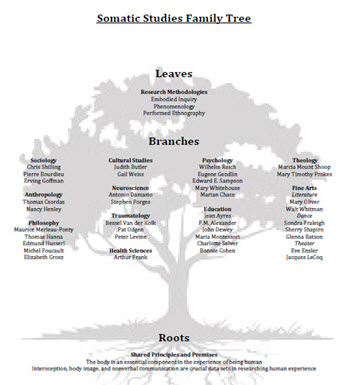
“Somatic studies” is an umbrella term that includes
somatic psychology (working with the experience of the body to support mental health),
somatic movement therapy (working with the experience of the body to promote improved movement functioning), and many forms of complementary and alternative medicine. A
somatic perspective also flourishes within the fields of education, philosophy, sociology, anthropology, performance studies, and dance.
What Makes This Program Unique
The program at Pacifica is in
depth psychology, with an
emphasis in somatic studies. This means that the program is grounded in the ideas and practices of depth psychology, with its emphasis on the unconscious, imagery, archetypes, and dreams. From that ground, we explore the intersections between the body and the unconscious psyche, connect image with sensation through active imagination, and the find the movement in dreams. We consider how physical symptoms may speak for the soul, and study the body’s role in the process of individuation.
In some ways, the program here is more tightly focused, in that it works within a single approach to psychological inquiry, that of depth psychology. In other ways, it is broader. Working from the interdisciplinary umbrella of somatic studies allows us to draw from a range of ideas and practices not typically addressed in somatic psychology programs.
How Pacifica’s Somatic Studies program is different from counseling or clinical psychology
Most other somatically-oriented graduate programs are either in somatic counseling or somatic psychology. At present, Pacifica offers the only doctoral program in the broader discipline of
somatic studies. As a research-based program, our degrees in Depth Psychology with an Emphasis in Somatic Studies do not lead to professional licensure as a counselor or therapist. Rather, students are given the opportunity to develop as scholar/practitioners – to become skilled in the teaching, research, and community service that engaged scholarship demands, and to take those skills into the world in a meaningful way.