

Eric Kalkhurst, an accomplished businessperson with a long history in China, is enrolled in the new fully online M.A./Ph.D. in Psychology, Religion, and Consciousness Online Program (PRC). He is making Pacifica a family affair, as his daughter is also enrolled with us. I’m delighted to learn about his previous work and what he looks forward to in the PRC program.
Angela Borda: Welcome in advance to the PRC program and studying at Pacifica. I was immediately intrigued by your professional work experience, as you bring a background that will be quite unique and dynamic for your cohort members. You spent most of your professional career as a businessperson in China. Retiring from such ventures, you are now entering our PRC Ph.D. program. What has led you here, from business to psychology, religion, and consciousness?
Eric Kalkhurst: I first came up to Pacifica in 2006 and was interested in writing on the American concept of Manifest Destiny. Americans drive to travel across the North American continent. The theory of Imminent Domain that developed could have its origin in Israel’s return from Egypt to the promised land. I thought that theme resounded well with what happened in the United States. It is also comparable to China’s expansion in Eastern Asia. The Chinese believed they were the “Central Kingdom” and thus had sovereignty over Asia. I was looking for a more scholastic atmosphere. Schools that teach mythology are as rare as hen’s teeth.
My daughter and son were both students at USC, so it was easy for me to come to Pacifica to talk to people while visiting my children. However, the requirement to come to Pacifica for lectures four days a month would not be feasible. So, I did not pursue a degree at that time. A few years later, my daughter became interested in mythology. She entered Pacifica’s Mythology Program. She is now at the Ph.D. stage. This is how I came to know Pacifica. During my daughter’s Pacifica classes, I met Dr. David Odorisio, and I told him that if they ever put mythology online, I would be the first student. Recently, he told me about the PRC program, and I discussed this unique program with several academics and decided to enroll.
Angela: Wonderful! I noticed you served as a China Specialist in the US Army Intelligence in Vietnam and Taiwan. Thank you for your service. This clues me into the cultural and political times in which you had your formative experiences in your twenties, and I wonder if that experience informs your interest in the program that will focus on consciousness and even psychedelics as possible healing modalities.
Eric: At the beginning of my Vietnam tour, I was in intelligence at the provincial district level. I worked primarily with the Vietnamese military and specialized American units, which gave me deeper insights into Asia. However, my interest in PRC primarily comes from my mother’s side of the family. My maternal grandmother was interested in herbs and poetry. She was from Tennessee. She was a published poetess. She developed my interest in many things, starting with nature and how the world worked in the non-western sense of a more natural path to the world. My ethnicities are European, Native American, Middle Eastern, African, and Mongolian. I got into multiculturalism very early. I have known about psychedelics since I was very young, since they are part of the Native American Church and herbal remedies. In the ’60s, I was at the University of Virginia, which, while we were aware of what was happening around the USA, we were not Berkeley. We were the polar opposite. At UVA, I was the business manager of the poetry and literature magazine, so I was aware of the cultural changes in the US, especially in terms of psychology, religion and consciousness. I was the first to wear jeans to a class with a coat and tie, which people considered not quite proper. I was a radical on campus, but not very much radical. I was so involved in my major in Chinese studies that the 60s did not really influence me.
The other interest I have always had was physics. My professor at Virginia was studying quantum physics, so one of the things I want to study is the relationship of the term consciousness to quantum consciousness.
Angela: You split your time between Hong Kong and Los Angeles. What is Hong Kong like?
Eric: I first went to Hong Kong in 1974, when it was under British control. I found a ferociously business-oriented city as it had been established as an entrepot in the 1800’s.
Angela: A few weeks ago, I saw a headline that 45 pro-democracy leaders were jailed. What is your take on the current political and cultural climate in Hong Kong?
Eric: What you saw was the last vestige of a turbulent period in Hong Kong’s journey from a British Colony to a fully integrated part of the People’s Republic of China. Such periods always have turbulent events. While we have had many protests during this period, some of which had over a million people marching, they were mainly peaceful. However, this last period had several episodes of violence, destruction, and the interruption of ordinary life, with excesses like firebombs being thrown down subway entrances. The majority of Hong Kong people, the Hong Kong government, and the Chinese government would not tolerate these events.
Most people see the change of government as inevitable and something they can live with. The American style of representative government has never been available in Hong Kong or China. Therefore, it is not missed or sought after by the majority of the population. Frankly, not much has changed in the lives of the majority of Hong Kong people. The trial of these people did not affect the daily lives of ordinary citizens who do not want to be involved in politics. We are a small town on the coast of China, with 8 million people. Life goes on.
Angela: Pacifica is introducing PRC as a fully online program, in part to make the degree available to people at all stages of their careers and lives who may need help leaving their commitments to come to Carpentaria for in-person sessions. Was the online aspect a draw for you in your current situation, and what are you most looking forward to about the program?
Eric: The online aspect allows me to participate. I could not do this if I had to be there in person. It is not a financial issue; it is a physical issue. Changing time zones would not allow me to be at my best. In comparison, doing it online allows me to participate freely. I participate in all of my Extension courses online, and I enjoy them. Getting my Master’s and PhD degrees is something I wanted to do right after I graduated from UVA. However, I had to go into the Army. So, I am finally getting a chance to pursue those degrees. The online ability will make the course much more international.
This course is a new frontier. Dr Odorisio is trying to integrate psychology, religion, and consciousness studies. This program is a massive undertaking. I can not find any other institution of higher learning even attempting to do this. This program should draw a substantial, diverse, and highly interesting set of students. I am honored to have been admitted to this program.
Angela: Thank you so much for speaking with me, and best of luck in your experience in the M.A./Ph.D. in Psychology, Religion, and Consciousness Online Program (PRC) in the Fall.
For those interested in learning more about this program, which is accepting applications for Fall 2026, visit us here.
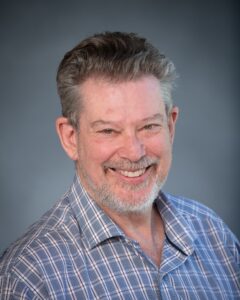
Eric T. Kalkhurst has spent fifty-five years in Asia, primarily in China. While in the US Army, he was a senior economic and political analyst on the People’s Liberation Army. He was one of the first American businessmen to reside in China, where his interests ranged from significant engineering projects to commodities trading. He was the first Director of Business Advisory Services for the National Council for US-China Trade. He has had a lifelong passion for Chinese philosophy and has studied in China, Taiwan and Hong Kong. Additionally, he has a degree in Chinese law and herbal studies, was Chairperson of the American Chamber’s China Committee, and has been the president of a Hong Kong-based martial arts association.

Angela Borda is a writer for Pacifica Graduate Institute, as well as the editor of the Santa Barbara Literary Journal. Her work has been published in Food & Home, Peregrine, Hurricanes & Swan Songs, Delirium Corridor, Still Arts Quarterly, Danse Macabre, and is forthcoming in The Tertiary Lodger and Running Wild Anthology of Stories, Vol. 5.