
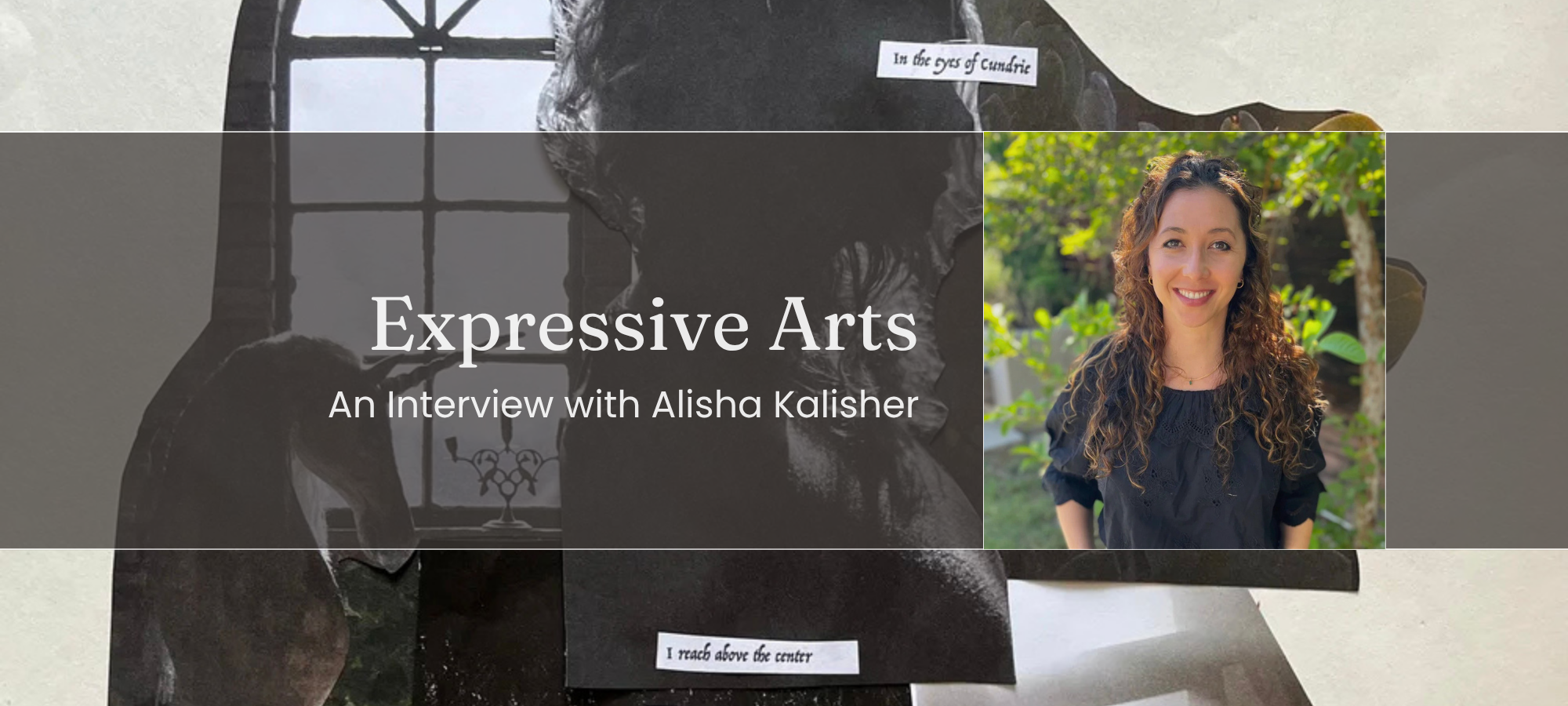
Expressive Arts: An Interview with Alisha Kalisher
Alisha Kalisher is a graduate of the M.A. Depth Psychology and Creativity with Emphasis in the Arts and Humanities program, and the founder of The Bella Arts Foundation, a nonprofit offering expressive and creative arts access to survivors of trauma. In a recent interview she details her experiences at Pacifica, and her work with expressive arts, journaling, and depth psychology.
Pacifica Graduate Institute: Can you tell us about your journey, what brought you to depth psychology and Pacifica? Did you find what you hoped for? What surprised you during your time there? How did the DCH program change you?
Alisha Kalisher: Right before my journey at Pacifica began, I was standing at the edge of exhaustion from over ten years in the music industry. Panic attacks had begun to visit me before performances, a stranger in my own body, and no matter what I tried, they would not relent. Eventually, I stepped back from performing, giving my nervous system a chance to breathe and reset. In that pause, I began to question who I was as a creative being if music was no longer the defining thread of my life.
Pacifica had crossed my path for years, appearing here and there, until it arrived fully in my awareness through Sheryl Paul’s The Wisdom of Anxiety. It felt like discovering a long-hidden fountain in the desert, waters rooted in depth psychology, quenching a thirst I hadn’t known how to name. Following that thread, I found the Depth Psychology and Creativity program, and I knew in my gut that this was the next step I had been seeking.
My time at Pacifica has reshaped the way I see myself and my work. I learned that creativity and imagination are not just tools but a path back to wholeness, a bridge to reclaiming agency over how we understand ourselves and our lives. I discovered that the purpose of creativity is not confined to a career or achievement, but to the deep and vital work of living fully in alignment with our inner truth. It gave me the courage to redefine what it means to be a creative human and the freedom to honor that in every part of my life.
Pacifica: You are doing some amazing work with your Expressive Arts Journal. Can you tell us about the inspiration for that project, and how it has unfolded? How have you been able to impact the lives of others in your community?
Alisha: My husband, four-year old daughter and I lost our home in the Eaton Fire last year. Leading up to the one-year anniversary of the fires that impacted us and my entire community, I began noticing how much of the collective experience was still living beneath the surface. While the immediate crisis had passed, many people were still carrying grief, disorientation, and fragments of memory that had not yet found a place to land. I felt a pull to create something that could hold space for continued processing. I hoped to offer something gentle and accessible, rooted in creative expression rather than only language.
From that impulse, I began developing a trauma-informed expressive arts journal intended to support reflection, emotional regulation, and meaning making through art, writing, and symbolic exploration. My intention was to create a container where people could encounter their experiences at their own pace, guided by prompts that emphasize choice, safety, and curiosity rather than pressure or interpretation.
As the work evolved, and after my personal experience with a multi-generational workshop I led for survivors, it became clear that healing in the community was not occurring in isolation but across generations. In response, I created developmentally attuned versions of the journal for children, adolescents, and adults. My hope is that these journals can function both individually and collectively, allowing families, classrooms, or community groups to engage in parallel processes of expression and reflection, each at an age-appropriate depth.
In this way, the journals are meant to support a multigenerational container for healing, where creative practice becomes a shared language for processing what has been lived through together. I have been thinking about how expressive arts can help bridge experiences that are often difficult to articulate directly, allowing imagination, image, and symbol to carry what words sometimes cannot.
Healing in community is vital, and offering this journal along with expressive arts workshops at no cost is my way of supporting my community’s ongoing recovery. Through these resources, I hope to provide a gentle, creative space where individuals and families can process their experiences together and rebuild stronger.
Pacifica: What does creativity mean to you? What does it mean to be a creative person? How did your studies at Pacifica help to shape these meanings for you?
Alisha: My time at Pacifica, along with my personal creative practice and work in expressive arts, has been deeply intertwined with the questions that first drew me to depth psychology. I have been exploring how individuals and communities metabolize trauma, how symbolic expression participates in healing, and how creative practices can support the integration of lived experience. To me, creativity is both a form of self-inquiry and a pathway toward healing, a birthright accessible to everyone. My studies at Pacifica helped me understand this truth on a profoundly personal level, which has empowered me to bring it into my work and into the world.
Pacifica: What would you say to someone who was considering applying for the Depth Psychology & Creativity program at Pacifica?
Alisha: If you find yourself hesitating about whether to apply for the Depth Psychology and Creativity program at Pacifica, that very moment of uncertainty is the perfect place to take the leap. This program invites you to explore deeply, uncover new insights about yourself, and build a path that will carry you forward in your life and work.
Pacifica: As you look ahead, what other goals or projects do you have on the horizon? What is your dream?
Alisha: My goal and dream is to make expressive arts and the healing power of creativity accessible to everyone. I will be creating a course, and hopefully many more in the future, to accompany my journal through my private practice, Essence Expressive Arts. I also plan to continue offering expressive arts workshops for survivors of trauma through my non-profit organization, The Bella Arts Foundation.
~***~
To find out more about the M.A. Depth Psychology and Creativity with Emphasis in the Arts and Humanities program, visit here. To stay up to date with Alisha’s work and upcoming offerings, you can sign up for her mailing list on her website, essenceexpressivearts.com.
Alisha Kalisher is an expressive arts practitioner and professional vocalist whose work bridges Depth Psychology and creative expression. She has performed on national stages and composed music for film and television, and now supports others in navigating life’s transitions through the arts. She is also the founder of The Bella Arts Foundation, a nonprofit providing expressive arts access to trauma survivors. To learn more about her work visit www.essenceexpressivearts.com.