
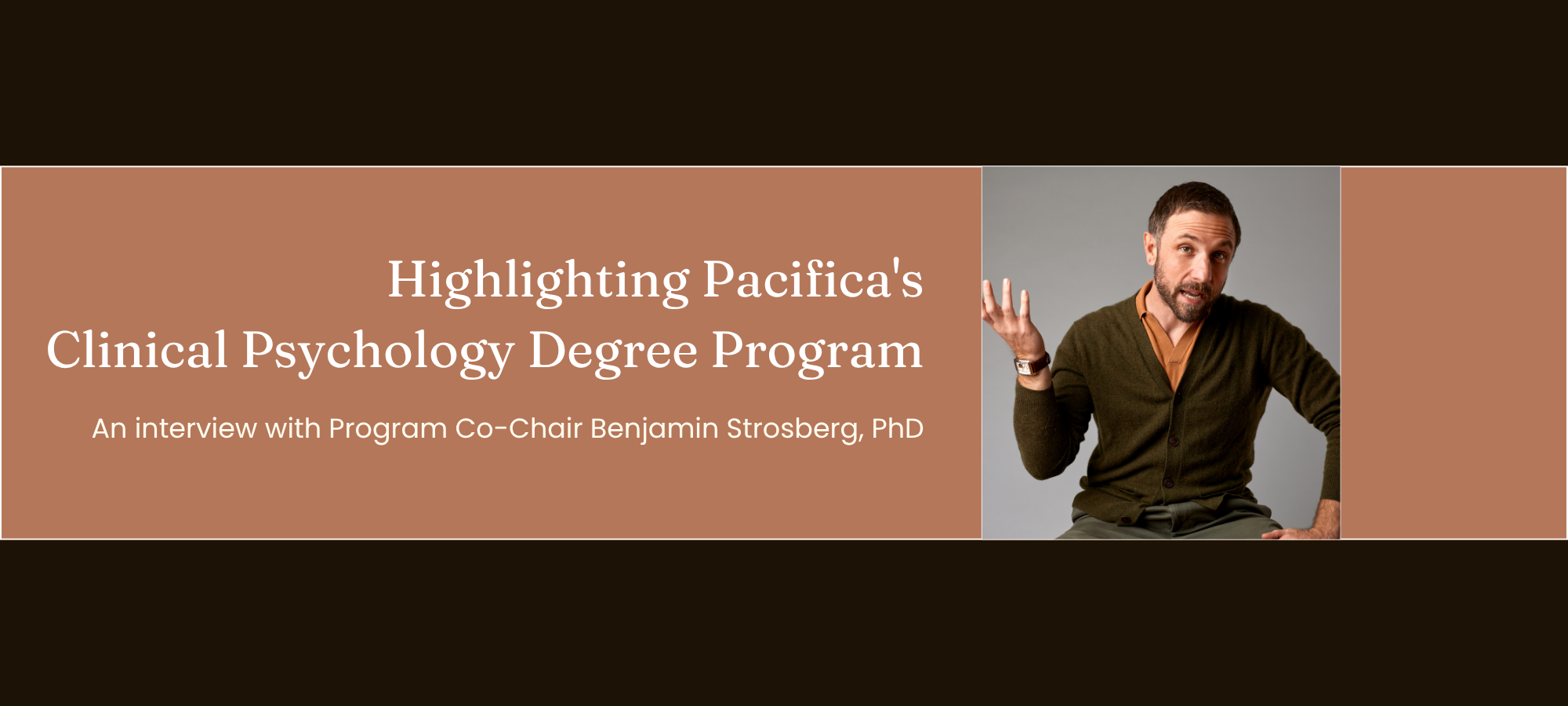
Highlighting Pacifica Graduate Institute’s Clinical Psychology Degree
Benjamin Strosberg, Ph.D., is an Assistant Professor and Co-Chair of Pacifica’s Clinical Psychology program. He was interviewed recently by Loralee M. Scott, MFA the Vice President of Institutional Advancement and Lifelong Learning at Pacifica. Dr. Strosberg highlights the core vision of the degree program, the experience of clinical training unique to the institute, and the work students are putting out into the world.
Loralee M. Scott: Pacifica Graduate Institute has become internationally known for its depth psychological approach to clinical education. How would you describe the core vision of the Clinical Psychology program?
Benjamin Strosberg: The core vision of Pacifica’s Clinical Psychology Department, as I see it, is animated by education across a wide range of depth-oriented approaches to clinical psychology, from Jungian and post-Jungian psychology to psychoanalysis, psychodynamic and relational approaches, phenomenology and hermeneutics, critical theory and systems theory. But it’s not just variety for its own sake. We see these traditions as incredibly important for addressing the core issues of our time, not only in relation to mental health and human suffering, but also in relation to the larger questions of what it means to be human, what it means to be a relational being, what it means to live in the time we are living in, and what we can do to make the world a better place to be, for humans and otherwise.
So, we really pull from all these resources, from the whole gamut of depth-oriented traditions in psychology, and bring them into conversation with the broader field where our students inevitably have to live and work once they leave our beautiful campus. You see this in our clinical courses and training, where we teach archetypal and analytic psychology, psychoanalysis, and evidence-based approaches to clinical psychology and clinical intervention from a depth-oriented perspective. And we are always asking what counts as evidence, what evidence means in our field, what it means in a broader philosophical sense, and how we can intervene ethically with patients or in society.
We also do this in our research labs. Same questions, different form. With Cris Scaglione, that means engaging in a depth-oriented approach to neurobiology and neuropsychology. In the Pacifica Psychoanalytic Research Collective, it means taking up questions related to the philosophical and psychoanalytic underpinnings of the human being. In the Emergent-Systems Lab, it means engaging in the psychocultural dimensions of human life, opening out into questions of social justice and social activism. In Brenda Murrow’s lab, this dynamic opens onto the question of what it means to be human in relation to other animals. She’s leading some really remarkable mixed methods research projects.
Across all of these spaces, we’re working with students to engage deep psychological, psychosocial, and, I should add, biopsychosocial questions. This is a thread that runs through both our clinical and scholarly training. So I might say that the core vision of the program is to train Pacifica graduates not just to practice clinically, though clinical work is still the backbone of the program, but also to carry forward this depth-oriented tradition as educators, researchers, and scholars, so that it continues to develop and remain alive in a world that so desperately needs it.
That’s really our mission, our vision, here in the Clinical Psychology Program. Students here are not just learning about a depth tradition. They are actively participating in its present and its future, helping to carry it forward in their own way. Students get a great education here, a real Bildung, that is, an education that forms you as a person, a citizen, a clinician. But they also become part of a living field where they can actually make a contribution. And to me, that’s what we’re doing here. It’s more than a training model. It’s a vision of clinical psychology that the field still very much needs.
Loralee: Can you describe the role of supervised clinical training and practicum experiences in the program?
Benjamin: Of course! Clinical training and our students’ experience as practicing clinicians is really fundamental to what we’re doing in the Clinical Psychology program, as you can imagine. Students are introduced to different orientations and philosophies, to different ways of understanding psychological suffering and thriving, what our aims might be in psychotherapy, what it is to be human, and how we might help people in various ways. All of that is essential. But the clinical experience is really where students begin to learn what this work actually is.
Loralee: Can you tell me a little more about that experience?
Benjamin: It’s when they start sitting in front of people in their practicum placements, talking with people, and recognizing the imperative that emerges in that encounter, really an ethical imperative, because someone comes through your door suffering and you’re being asked to respond. What do you do? There is no real substitute for that experience, and no book or professor can fully teach that component of the work.
That’s not to say that this is the only place where they get that experience. One other place where students learn this piece is in supervision, where training clinicians talk about their cases and get feedback and mentorship. In supervision, they learn not only from the supervisor’s thinking about the patient, but also from the relationship with the supervisor itself. Sometimes that happens through something like a parallel process, where the supervisor is able to understand something about the patient, and about the treatment, through what is being enacted or communicated in supervision. And, of course, an important part of our training is also the students’ own psychotherapy, which is a required component of our training program. In personal therapy students develop a deeper understanding of themselves, of clinical and unconscious processes, and of what it means to be in that kind of relationship. That’s so important.
Then there’s also the relational educational component of the program more broadly, where students are learning in relationship to one another as a cohort. The cohort model is so important to our work because students are not just being trained individually. They’re being formed in and through a shared relational experience with others. It’s really an experience unique to Pacifica’s intensive residencies. I got a little taste of it when I was in graduate school at Duquesne University but nowhere near the way students grow with their cohort here at Pacifica. It’s exciting to witness.
Loralee: What kinds of dissertation or research projects are emerging from Pacifica’s clinical students today?
Benjamin:I’m really glad you asked this question, Loralee. I’m really proud of the dissertation work and the research our students are doing in the program. And our faculty of course. It’s one of the things that really distinguishes Pacifica’s Clinical Program. Along with our unique depth-oriented perspective, and the way we bring in clinical orientations from across the depth traditions, we’re also producing rigorous depth-oriented research.
The kinds of research projects emerging from our program today are really engaged with the deep questions of our time. Some are closely tied to the work people are doing in the clinic, around psychotherapeutic and analytic technique and practice. Others are engaging in the theoretical or ethical underpinnings of those practices, really digging into the philosophical as well as the lived, experiential and embodied dimensions of the questions that are emerging in the literature. And what I really want to emphasize, here, is that our students are making real contributions to the field.
Loralee: Can you give a few examples of the kinds of projects you mean?
Benjamin: I’m currently helping to direct some really fabulous dissertation research. One project looks at the way clinicians can learn from ancient monastic reading practices called Lectio Divina. That one has the brilliant David Odorisio from Pacifica’s Psychology, Religion, and Consciousness Program, as well as Lacan scholar, Derek Hook, serving as readers. There is also a powerful psychoanalytic project on what the student is calling “cyber-psychosis,” dealing with the Japanese hikikomori phenomenon from a French psychoanalytic perspective and what that helps us understand about our current technological milieu. I have a student working phenomenologically on the lived uncanny experience of COVID-19, and another exploring depth contributions to addressing the climate crisis and where they go astray. It’s quite a range.
And those are just my students, the ones drawn to my mentorship, for one reason or another. The range across professors is even broader. Students are studying sex, grief, chakras, Kant, embodied communication, borderline personality disorder, autism, archetypes, I could go on and on. It really is outstanding, the diversity of interests and interventions represented here in the field of psychology. And students don’t just wait for the dissertation phase to do this research, many of them are presenting at conferences and working on publications. You can probably tell, there’s a lot of energy around student scholarship in our program, these days.
Loralee: What do you think makes that kind of work possible at Pacifica?
Benjamin: Well, this is all very important to me. When you go through our program, you’re not just studying other people’s theories or techniques and learning how to apply them like a technician. Of course, students are learning technique and method for scholarship and clinical practice, but they’re also learning to think through the deeper assumptions and foundations that underlie those practices, techniques, and theories. That’s what allows them to actually make a contribution to the field.
Loralee: So, what is different about the way students are trained to approach research here?
Benjamin: I guess I’d say that our students have the freedom, but also really the demand, to become experts in a particular area that’s meaningful to them, and to root their project in a real gap, a real question, or a real debate emerging in the field, an unanswered question that matters. At the same time, and this is very much part of Pacifica’s heritage, students are also being called by the work itself, and in some sense by what many of us here at Pacifica would call Psyche. They have a transference to their work, if you’ll forgive my use of jargon. By that I just mean that the work is not neutral for them, that they are drawn to it in ways that are personal and unconscious as well as intellectual, and they need to understand the way they are implicated in the research they’re doing.
This is just like it is in the clinic where we have to recognize that we’re implicated in the treatment, that we show up, that we’re in the room, that we’re engaged in a relationship. Something similar happens in research. We’re in a relationship to the field, to knowledge, to knowledge production, and inevitably to our own writing and creative process. That’s an essential part of the research process here. It can be a real soul-searching process, one that is intimate and beautiful and also genuinely challenging for students. It asks something of them that they may not be asked in quite the same way in other institutions, where there can be a bit more distance from the work. That certainly doesn’t mean students have to write about something explicitly autobiographical, but we do find that you can’t really escape yourself in these kinds of endeavors. All writing is a kind of signature. Wasn’t it Derrida that said that?
I think that’s part of what makes the training here so valuable and, for most students, really life changing. They’re stepping into a remarkable legacy. They encounter the work and legacy of people like Avedis Panajian, Michael Sipiora, Marybeth Carter, Robert Romanyshyn, Christine Downing, James Hillman, Douglas Thomas, some of these legends still teach for us. And then today you have faculty like Camille Jarmie, Peter Dunlap, Cris Scaglione, Brenda Murrow, Sadie Mohler, Kevin Volkan, all bringing their own tributaries into that river. I bring my own weird confluence of French psychoanalysis, phenomenology, critical theory, and Jewish studies. So students are not just inheriting a curriculum, though that’s true as well. They’re inheriting a living tradition, one that keeps growing through the different orientations, commitments, and I think it would be fair to say, personalities of the faculty here.
Loralee: Clinical psychology is changing rapidly. How do you see Pacifica helping shape the future of the field?
Benjamin: Yes, clinical psychology is changing rapidly, and indeed, I do think Pacifica, and depth psychology more broadly, has an important role to play in shaping where the field goes. Part of that is that we’re training clinical psychologists to be critical thinkers, people who can make persuasive, rhetorically ethical arguments about the value and dignity of human life and meaning, and about the fact that human and embodied life always exceeds the categories we use to try to describe it.
We’re training students to take seriously that language matters, that what escapes our linguistic grasp matters, that what does not fit neatly into a diagnostic frame still matters. And I think the broader field of psychology, even the mainstream field, increasingly needs that, and I think, on some level, knows it needs that—what I would call a human science approach to psychology. It needs clinicians and researchers who can bring that kind of depth, humanity, perhaps even posthumanity, as our colleague Dylan Martinez Francisco said in a recent interview. We need a real capacity to tolerate complexity and ambivalence in the work. We ask that of our patients all the time. The least we can do is ask it of ourselves.
On a very practical level, the field also needs more qualitative researchers, and we do that really well. There are just not enough programs training qualitative researchers with the kind of rigor and philosophical grounding that we offer, and I think the field needs that if it is going to remain connected to actual human experience and not just to what can be most easily measured, packaged, and sold.
Loralee: Why do you believe depth psychology will continue to play an important role in the evolution of psychotherapy?
Benjamin: You know, that’s a tough question for me. I try to stay away from the word evolution in psychology. It’s so loaded. But I will say that depth psychology will continue to matter. Human beings will continue to suffer in ways that exceed simple categorization. They will still speak in ways that reveal more than they intend, they will still be born of the tension between social, psychological, and biological factors, they will still be born of lack and desire, struggle in relationships, live with meanings, live time. Depth psychology gives us the language and lens we can use to attend to these aspects of human life. And that is essential, absolutely essential, for any future psychotherapy. Or social analysis, for that matter. There is always more going on in psychical life than what appears on the surface, and more on the surface than what appears, as Michel Foucault put it somewhere. Did you know that before he was known as a philosopher, his early work was a deep engagement with existential psychiatry? He wrote about Binswanger. Anyway, that would take us down a different road and we’re at the end. What I really want to say most of all, I guess, is that depth psychology offers a kind of intellectual humility by being open the multifarious and sometimes essentially irreconcilable ways of understanding the human condition. They all have a place here. And if you’ve stuck with me this far in the interview, you probably have a place here too.
~***~
To learn more about the Clinical Psychology degree program, please visit here.

Benjamin Strosberg, PhD is Assistant Professor in the Clinical Psychology program at Pacifica Graduate Institute and a psychotherapist in private practice. He earned his doctorate in Clinical Psychology from Duquesne University. Dr. Strosberg’s research is deeply rooted in the human science tradition, traversing critical, psychoanalytic, and phenomenological approaches. Currently, his research carves two primary paths: a renewed clinical engagement with French psychoanalyst Jean Laplanche and a critical examination of racism and anti-Semitism. His published work spans diverse topics, including teletherapy, psychosis, Jewish studies, and education, and engages with seminal thinkers such as Jacques Lacan, Emmanuel Levinas, and Theodor Adorno. Committed to advancing critical reflection, Dr. Strosberg aims to foster nuanced approaches in both academic and practical contexts. Through teaching and research, he strives to deepen understanding of pressing issues in clinical psychology while promoting interdisciplinary perspectives that can inform effective (and affective) interventions and social change. His first book is titled Anti-Semitism at the Limit: Critical Theory and Psychoanalysis (Palgrave Macmillan).

Loralee M. Scott, MFA, is Vice President of Institutional Advancement and Lifelong Learning. As an entrepreneurial leader, she brings a proven track record of successful organizational leadership as well as post-graduate, depth psychologically informed curriculum design, development and delivery.
Loralee holds an MFA degree in inter-disciplinary studies focused on somatic depth psychology and cultural transformation. Her work as an award-winning choreographer is featured in Grief and the Expressive Arts published by Routledge and was responsible for the creation and passage of anti-trafficking legislation. A respected thought leader, she has contributed to Jungian academic journals and lectured internationally in several countries.
Loralee’s blend of strategic vision and hands-on experience equip her to effectively guide initiatives that bridge academic excellence with real-world impact. Her leadership exemplifies a commitment to lifelong learning and the transformative potential of depth psychology in today’s complex global landscape.