
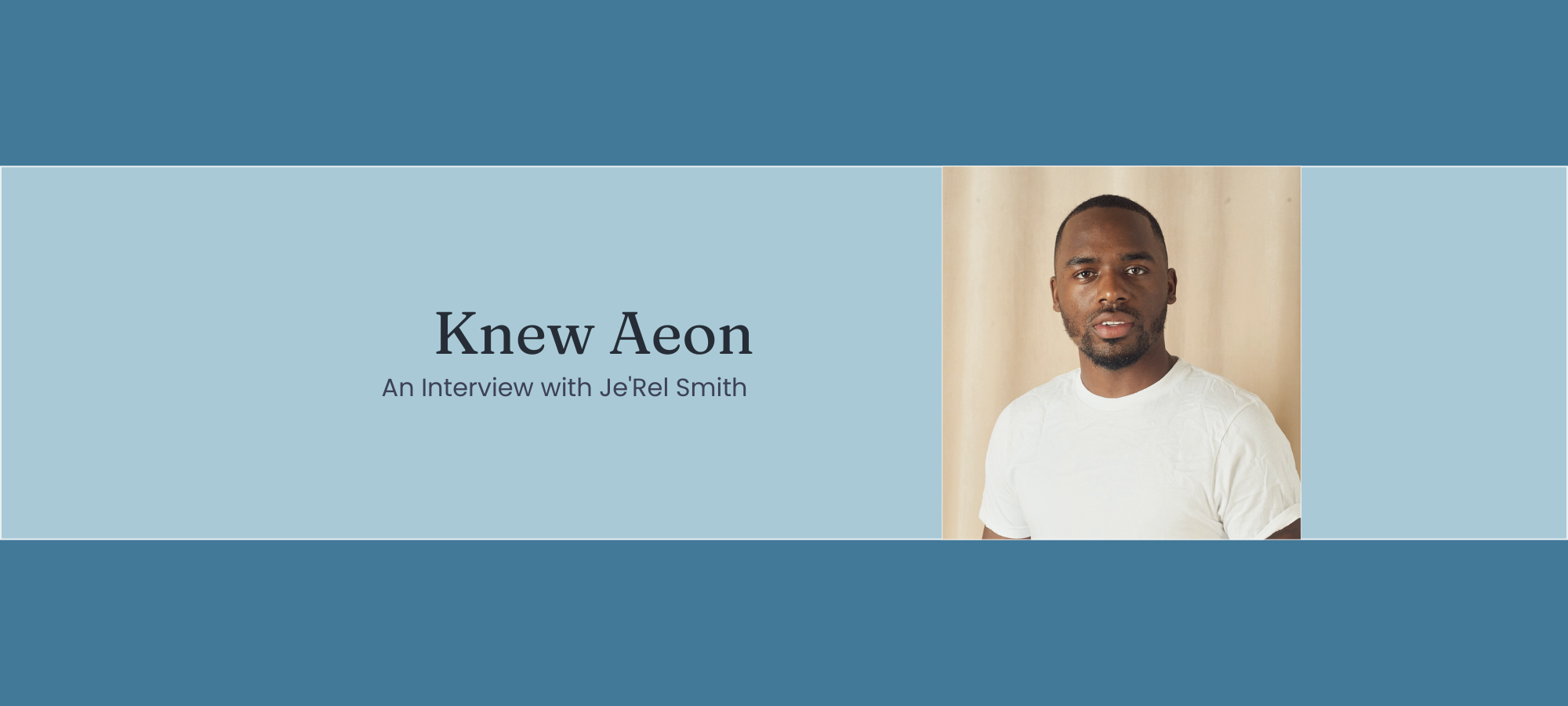
Knew Aeon: An Interview with Je’Rel Smith
Je’Rel Smith is a new graduate of the M.A. Depth Psychology and Creativity with Emphasis in the Arts and Humanities program, and the founder of Knew Aeon. In a recent interview he details his experiences at Pacifica and his new ventures.
To find out more about the M.A. Depth Psychology and Creativity with Emphasis in the Arts and Humanities program, visit here.
Angela Wood: I understand you have finished your last class needed to complete the M.A. Depth Psychology and Creativity with Emphasis in the Arts and Humanities program. Congratulations! To start, please tell us a little about your background and what led you to depth psychology.
Je’Rel Smith: Growing up, I often felt different in how deeply thoughtful I was. I found myself reflecting on life, meaning, and human experience in ways that did not always feel common among my peers. That tendency toward deep reflection eventually became a guiding force in my life. Around 2021, I experienced what I can best describe as a spiritual awakening, both physically and mentally. That moment became a turning point that led me to what felt like a pot of gold. I developed a deep desire not only to understand myself more, but to innerstand the experiences I had been going through for much of my life. Often when people hear the word psychology, they assume it is the study of other people. For me, it was the opposite. My interest was rooted in understanding my own experiences more deeply and finding language for things I had felt, sensed, or encountered internally. I wanted to better articulate those experiences and to be in the company of others who spoke a similar language of symbolism, dreams, creativity, and the psyche. Before returning to school, I had a conversation with a therapist where I shared that if I spoke openly about certain dreams and experiences I had, people might think I was crazy. Yet I knew those dreams carried meaning and significance. She told me that there was a community of people who would understand experiences like these, even when I could not yet fully articulate them myself. She encouraged me to return to school and explore those questions further. At first, I resisted the idea. It took me about a year to truly sit with it. Looking back, I realize I was being a bit stubborn. But eventually I asked myself a simple question: Why am I not pursuing further education? Why am I not giving myself the opportunity to understand myself more deeply? That question ultimately led me to Pacifica. Studying depth psychology allowed me to integrate many aspects of my life that had previously felt separate. As a creative, working through photography, film, and storytelling, I have always been drawn to themes of identity, transformation, symbolism, and the inner journey. Depth psychology provided a framework and language for exploring those themes while deepening my understanding of the relationship between creativity, dreams, and the unconscious. In many ways, the program gave form to questions I had been living with for years and allowed me to continue the ongoing process of understanding the self and the deeper patterns that shape human experience.
Angela: What did you most enjoy or value about the program? How did it change you?
Je’Rel: During my time in the program, I learned so much about myself. Perhaps most importantly, I learned a new language to articulate experiences I had been having for much of my life, particularly my dream world, which has always been very potent for me. Through the program, I deepened my understanding of the psyche, spirit, and God, or whatever name one chooses to give to that which is greater than us. For me, that presence often speaks very directly through my dreams. Studying depth psychology helped me understand those experiences more clearly and allowed me to grow more comfortable with them and with myself. It gave me confidence to show up in the world in a way that is both artistic and deeply thoughtful. One of the things I valued most was the way the program opened new ways of learning and new ways of seeing. The shared perspectives among my classmates were incredibly meaningful. We explored case studies and concepts that closely resembled things I had personally experienced, such as synchronicities, active imagination, and dream work. Before this program, I had lived through many of these experiences but did not have the language to describe them. Now I do. For example, I can speak about the significance of the inner child in my life. I believe the world we live in often conditions us to disconnect from that part of ourselves, but for me, strengthening that relationship has been essential to who I am and to the way I move through the world. At times, the journey was also challenging in a different way. As an African American and often the only Black man in certain spaces, there were moments when the environment initially felt unfamiliar or uncomfortable. Yet I chose to continue showing up for myself. I also felt a responsibility to show up for those who may come after me and for the many people who may benefit from seeing someone like them pursuing this work. My presence in those spaces became part of the journey itself, reminding me that depth psychology, creativity, and the exploration of the psyche belong to everyone. DCH did not just give me knowledge. It gave me language, community, and a deeper trust in my own inner experiences and it affirmed that the things I had been sensing, dreaming, and reflecting on for years were not things to hide from but things to explore, understand, and express through both scholarship and creativity.
Angela: Did you find any particular themes came to the surface during your studies, and what impact did they have on you?
Je’Rel: One of the most consistent themes throughout my papers that was really important was a growing better understanding of myself, my ancestors, lineage and using that through different modalities and passing it on to the generations that come after me. Pacifica was a safe place to do so, that was different from the norm. For example, I grew up Christian, and often we just had to accept what was told to us. Pacifica gave me space to explore all of the other things I’d been interested in without feeling guilt or shame about what I was raised to be and what I have grown to explore. That relates to my ancestors and other modalities to create and invoke things from the past. Ancient Egyptian culture is really important to me and Pacifica gave me the space to explore that comfortably as well.
Angela: I understand you created the website for Knew Aeon as your Master’s Thesis. What is Knew Aeon and how did it intersect with your time at Pacifica?
Je’Rel: Knew Aeon is my production company as well as a mental health and wellness space for creatives and my clients. I’m doing life coaching with different modalities through live events. One event I held recently was “Rewriting the Narrative for all American Men.” Spencer Paysinger, the producer and director of All American, spoke on the panel along with other creatives. We discussed what it’s like to be a black man in America and how to deal with emotions and trauma and show up as your most authentic self.
The website is shaped around what I wanted to do once I graduated. Pacifica aided me in executing it in ways that were more impactful and put all of my skills and offerings in one space. Not just a form of therapy in terms of talking, but creative ways as well. Within the BIPOC community, when we talk about therapy, one can be quick to dismiss it in terms of fear of sharing feelings. But I’m able to meet people where they are.
Angela: You describe Knew Aeon as being more than a marketing and production company, but also “facilitators of mindful experiences, champions of wellness, and advocates for the transformative power of art and culture.” How have art and culture been transformative for you and how do you intend to bring that same transformation to others?
Je’Rel: Art and culture have been transformative for me because they gave me a language when words alone were not enough. There have been many moments in my life where I felt something deeply but did not yet have the vocabulary to explain it. Through art, whether photography, film, or storytelling, I was able to express those inner experiences and make sense of them. It allowed me to show up in a way that felt authentic to who I am. Much of my work is rooted in the idea that art can serve as a bridge between the inner world and the outer world. Through the creative process, I have been able to explore my own identity, reflect on dreams and experiences, and better understand the patterns and emotions that shape who we are. Being able to create and tell stories through my own lens has been one of the most empowering parts of that journey. With Knew Aeon, my intention is to create spaces where others can experience that same sense of discovery and expression. Whether through visual storytelling, collaborative projects, or mindful creative experiences, I want to give people the opportunity to connect with their own voice and perspective. Art has the power to help people see themselves more clearly, to reflect on their experiences, and to feel seen in ways that words alone sometimes cannot accomplish. For me, transformation happens when people feel safe enough to express what is true for them. My goal is to use art and culture not just as a form of content, but as a medium that invites reflection, connection, and a deeper understanding of ourselves and one another.
Angela: What kinds of needs do you see as most pressing in Los Angeles and what kind of community are you forming in response to that?
Je’Rel: One of the most pressing needs I see in Los Angeles is a sense of genuine connection. The city is full of creativity, ambition, and opportunity, yet many people still experience a deep sense of isolation. In a place where people are constantly creating, performing, and building careers, there is often very little space to slow down, reflect, and connect with others in a meaningful way. Another need I see is around mental and emotional wellness, particularly within creative communities. Many artists, creators, and entrepreneurs are navigating pressure, comparison, and burnout while trying to sustain their passions. There are not always enough spaces where creativity and wellness are held together rather than treated as separate things. The community I am forming through Knew Aeon is centered around bringing those elements together. My goal is to create environments where creativity, reflection, and human connection can exist in the same space. Whether through collaborative art experiences, storytelling, or wellness-centered gatherings, I want people to feel like they can show up as their full selves rather than just the version of themselves that is performing for the world. The community I hope to cultivate is one where artists, thinkers, and creators can connect with one another in a more intentional way. A space where people are encouraged not only to create, but also to reflect, recharge, and support each other in the process. I believe when people feel seen and connected, creativity becomes more meaningful, and the impact of that creativity can extend far beyond the individual.
Angela: What’s next for you and Knew Aeon? Any plans or events we might like to know about?
Je’Rel: Looking ahead, I see Knew Aeon continuing to grow as both a creative studio and a platform for meaningful community experiences. While we will always focus on visual storytelling through photography and film, my vision is to expand the ways we bring people together around creativity, reflection, and wellness. One of the directions I am most excited about is creating more intentional spaces for artists, thinkers, and creators to gather. Los Angeles is full of incredible talent, but many people are still searching for spaces where they can slow down, share ideas, and feel a sense of genuine connection. Through Knew Aeon, I want to host experiences that bring together art, conversation, and mindfulness in ways that encourage people to reconnect with their creativity and with each other.
Angela: Thank you so much for sharing about your experiences, and best of luck with Knew Aeon and your future book.
~***~

Jerel Smith is a depth psychologist, creative director, and scholar-artist whose work lives at the intersection of psychology, photography, and storytelling. Based in Los Angeles, he is the founder of Knew Aeon, a creative studio and cultural platform dedicated to mindful experiences, storytelling, and the transformative power of art and culture. His practice centers on the unseen inner worlds of individuals, particularly introverts, dreamers, and creatives who often feel misplaced in today’s fast-paced society. Through photography, film, writing, and facilitation, Jerel creates vessels for belonging, reflection, and self-expression. His visual and narrative work explores themes of transformation, spirituality, identity, and the relationship between creativity and the psyche.
Jerel holds a Master’s degree in Depth Psychology and Creativity with an Emphasis in the Arts and Humanities from Pacifica Graduate Institute. His perspective is shaped by a lifelong sense of connection to the cosmos and the universal, a lens that continues to inform his artistry and worldview. Whether behind the camera, facilitating creative gatherings, or writing on themes of healing and identity, Jerel’s work seeks to illuminate the quiet voices that often go unheard and transform creative expression into a pathway of inclusion, imagination, and inner awakening.
Angela Wood is a writer for Pacifica Graduate Institute, as well as the editor of the Santa Barbara Literary Journal. Her work has been published in Food & Home, Peregrine, Hurricanes & Swan Songs, Delirium Corridor, Still Arts Quarterly, Danse Macabre, and is forthcoming in The Tertiary Lodger and Running Wild Anthology of Stories, Vol. 5.