
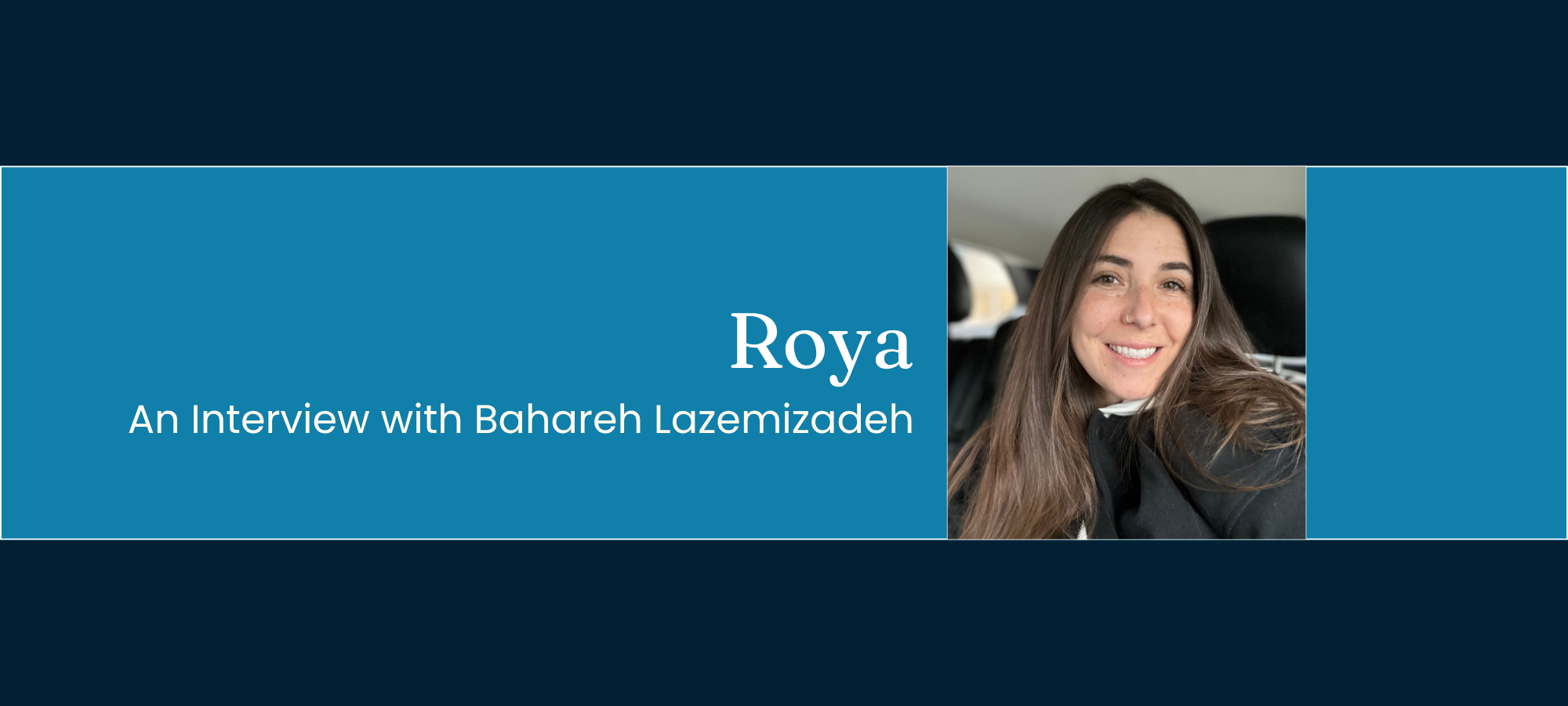
Roya: An Interview with Bahareh Lazemizadeh, MA, LMFT
Bahareh Lazemizadeh is an alumnus of our Masters in Counseling Psychology program. Bahareh is also a dual licensed therapist who provides trauma-informed therapy to individuals, groups, and families across California. Her work with Roya Wellness uses clinical care and reentry support to help individuals as they rebuild, heal, and grow.
Pacifica: Please tell us about your background and what led you to psychology and Pacifica?
Bahareh Lazemizadeh: My background has always been rooted in human service work. Even as a child, I found myself drawn to people’s stories and emotions. I still remember being in fourth grade, assigned as a “conflict manager” on the playground walking around at recess helping classmates resolve disagreements and then documenting the resolutions. Looking back, that experience planted a seed in me. I loved being someone others could turn to, someone who brought a sense of calm or clarity into difficult moments.
Throughout my adolescence and early adulthood, I continued working in roles that required direct human connection. I earned my A.A. in Social Science at Sacramento City College, then my B.A. in Sociology at Sacramento State. After finishing my undergraduate degree, I felt a sense of incompletion. I was not done learning, but I was not entirely sure what direction to take. I knew I wanted to stay connected to people and did not want a career that felt isolated or narrow.
When I discovered Pacifica Graduate Institute, something clicked. Pacifica offered a depth-oriented clinical training that spoke to my desire for a broader, more soulful approach to therapy. It also offered the dual-license pathway, which felt expansive and aligned with my desire to work across multiple modalities. As soon as I completed my interview at Pacifica, I knew there was no turning back. It felt like the right container for the work I wanted to do and the person I was becoming.
Pacifica: While studying in Pacifica’s M.A. in Counseling Psychology, your thesis was “The Labels That Bind Us: Rehumanizing the Dehumanized.” How did you find this topic, and in pursuing it, what realizations did your thesis bring to light?
Bahareh: My thesis began with an interest in labeling theory and the ways labels shape people’s identities and trajectories. During my undergraduate years at Sacramento State, I encountered the term hypercriminalization: the phenomenon of treating someone as deviant before any deviant behavior occurs. It stayed with me, especially as it related to young people of color, youth in low socioeconomic environments, and adolescents who are frequently labeled as “too loud,” “defiant,” or “restless.”
These labels often function as early forms of social punishment and can create self-fulfilling prophecies. When you are repeatedly told you are “bad,” it becomes easy to internalize that narrative. As I researched, my thesis shifted from a purely theoretical lens to a more embodied and human one. I began entering facilities, engaging with people directly impacted by the justice system, and seeing how profoundly these labels shape internal experience.
What came forward was a deep recognition of how essential re-humanizing work is. People who are system-impacted often have limited access to clinicians who understand the weight of these labels or the trauma of systemic dehumanization. My thesis reinforced something I continue to believe today: that healing often begins with returning to one’s own humanity and having a therapeutic space where dignity, complexity, and personhood are restored.
Pacifica: You currently work for Land Together, “one of the only organizations in the country working at the intersection of environmental justice and criminal justice system reform. Through in-prison and reentry programs and services, coalition-building, and advocacy initiatives, Land Together brings people together to grow, heal, cultivate community, and build a more just, humane, and sustainable world.” What inspired you to work with people who are trying to transition from the criminal justice system to the world outside of incarceration?
Bahareh: In the beginning, I was not fully sure what drew me to this work. Even writing my thesis, I felt a curiosity I could not yet explain. But as I learned about synchronicity during my time at Pacifica, things started making sense.
I grew up with a family member, my uncle, who had been incarcerated. His absence created a silence in our family system. As a child, I remember feeling curious about him, wondering who he was, and wanting connection. That longing stayed with me. Looking back, I recognize that my work in reentry has also been a form of shadow work, reconnecting with a part of my own family story that was avoided or unspoken.
The first time I stepped inside San Quentin in 2009, something stirred in me. I wanted to understand the men inside on a human level, beyond the labels that were placed on them. Over time, I recognized how deeply I was called to this work: to help people feel human again after years of being treated as less-than, and to walk with them as they rebuild identities beyond incarceration.
After more than a decade in the reentry world, I know this is where I am meant to be. It is meaningful, soul-level work that connects the personal with the collective, and the psychological with the systemic.
Pacifica: By looking beyond labels and seeking the human in dehumanized circumstances, what kinds of catharsis or healing do you see in your work as a reentry manager? And does depth psychology play a role in this?
Bahareh: As a reentry manager, I have the privilege of walking with people from the inside out and supporting them while incarcerated and continuing that relationship post-release. This transition carries an entire spectrum of emotion: anxiety, hope, fear, joy, overwhelm, excitement, grief, and liberation.
I often describe reentry as a bridge, and my role is to help people build stability and safety before they cross into the free world. Knowing someone is waiting for them, believing in them, and holding space for their complexity is profoundly healing.
Depth psychology is woven into every aspect of reentry work. There is immense shadow work involved: confronting old patterns, examining the internalized messages of incarceration, and navigating the difficult emotions that surface during reintegration. Many people must create new boundaries with family, avoid old neighborhoods that could compromise their progress, or grieve relationships they can no longer return to.
This process reminds me of mythic journeys, like Inanna’s descent, Orpheus traveling to the underworld, or the many heroes who face the shadow before returning transformed. Reentry is its own descent and return: an underworld journey of stripping away old identities and reclaiming the self. The work of healing often requires facing the “dark side” with honesty, compassion, and support, and emerging with a more integrated sense of who one is becoming.
Pacifica: The title of your private practice, Roya, means vision or dream in Persian. What kind of work do you undertake with clients to help them find their dreams?
Bahareh: “Roya” reflects my belief that dreams and visions guide us toward individuation, autonomy, and authenticity. At Roya Wellness, I help clients tap into their inner world, their hopes, their instincts, their emotional truth so they can create lives aligned with who they are becoming.
For many clients, especially those who are formerly incarcerated, dreaming can feel unfamiliar or even unsafe. My role is to create a therapeutic environment where they can slowly reclaim that ability to imagine new beginnings, second chances, and parts of themselves that were silenced or suppressed.
The work we do includes building awareness, strengthening emotional regulation, and cultivating confidence. It is deeply person-centered and honors each individual’s cultural background, lived experience, and healing pace. Although many of my clients were formerly incarcerated, Roya welcomes anyone seeking a space to transform, reconnect, and grow.
Pacifica: On top of all the above, you also teach psychology inside prisons. What drives you into this work and how does the experience differ from teaching psychology in an educational setting?
Bahareh: Teaching psychology inside Folsom State Prison and Mule Creek State Prison is one of my favorite parts of my work. Although the classes take place inside a correctional environment, they are held in the education building, a space that feels like its own sacred container.
In the prison yard, people must follow strict racial and cultural rules about who they can associate with. But inside the classroom, those barriers fall away. Students sit together across ethnicities, collaborate on group projects, and form a learning community that is truly inspiring. It is one of the most magical parts of teaching inside.
Many of my students returned to education for the first time while incarcerated, some after dropping out in middle school or high school. Watching them dare to try again, to believe in themselves, and to re-enter the world of learning is profoundly moving. Psychology gives them tools to understand themselves: why they react the way they do, how their nervous system operates, or what early experiences shaped their patterns.
When a student comes up to me and says, “Professor, this chapter helped me understand myself,” it is an indescribable gift. These moments remind me of my own journey… the fears I had before entering graduate school and how Pacifica held me in a way that made me feel capable.
Pacifica was the perfect fit for me, and teaching inside reminds me daily of the transformative power of education, self-understanding, and the courage to begin again.
Pacifica: Thank you so much for speaking with us and best of luck with the work you do. It is so very needed in the world.
~***~

Bahareh Lazemizadeh, MA, LMFT, is a dual licensed therapist who provides trauma informed therapy to individuals, groups, and families across California. While simultaneously pursuing their licensures, Bahareh authored an academic thesis addressing the impact of Hypercriminalization and proposed therapeutic approaches for mental health professionals to support their communities. Being passionate about this work, Bahareh has been actively involved with the in-reach and re-entry community for over ten years and transitioned to full-time roles in the field in 2021. Bahareh’s commitment lies in supporting, individuating, and enhancing the quality of life for people who are system impacted, employing holistic and mental health awareness approaches.