
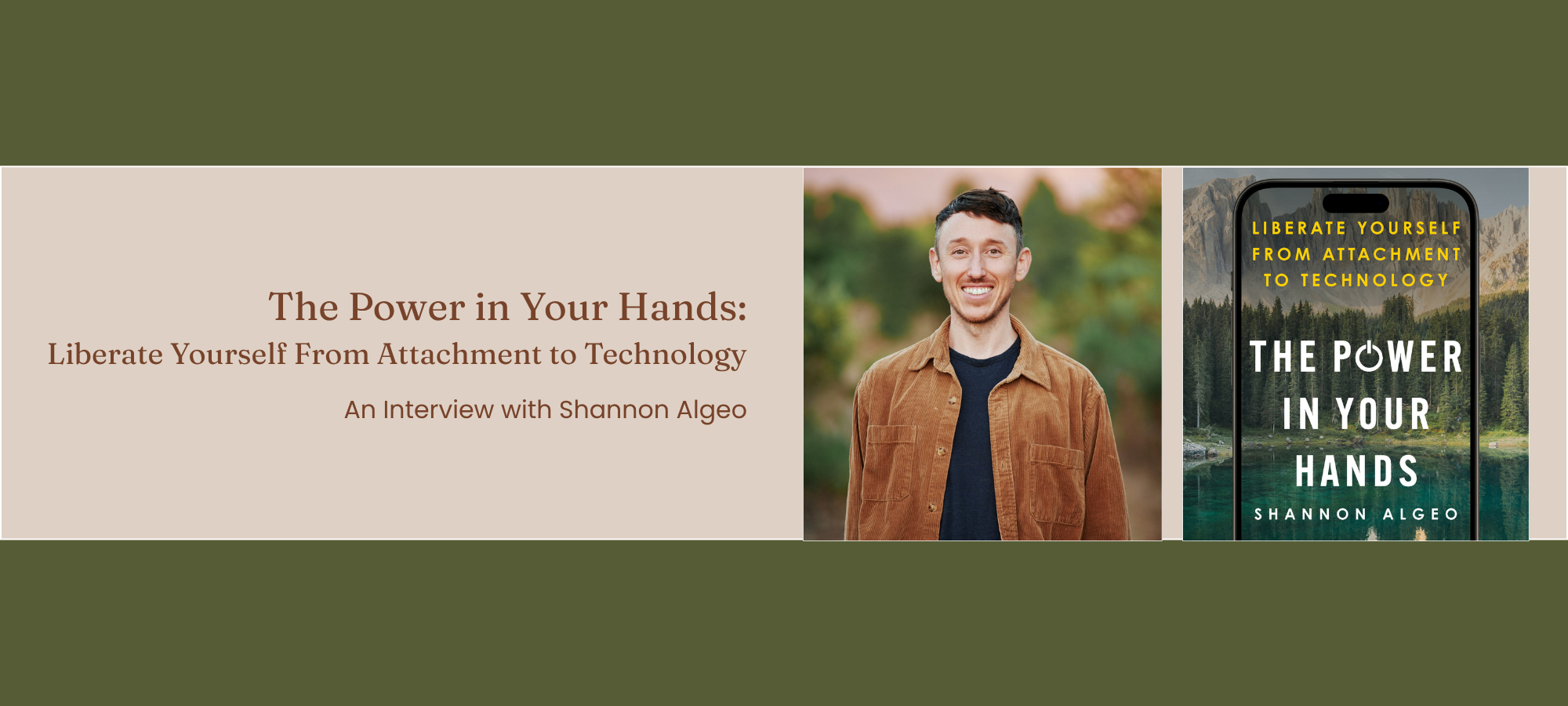
The Power in Your Hands: An Interview with Shannon Algeo
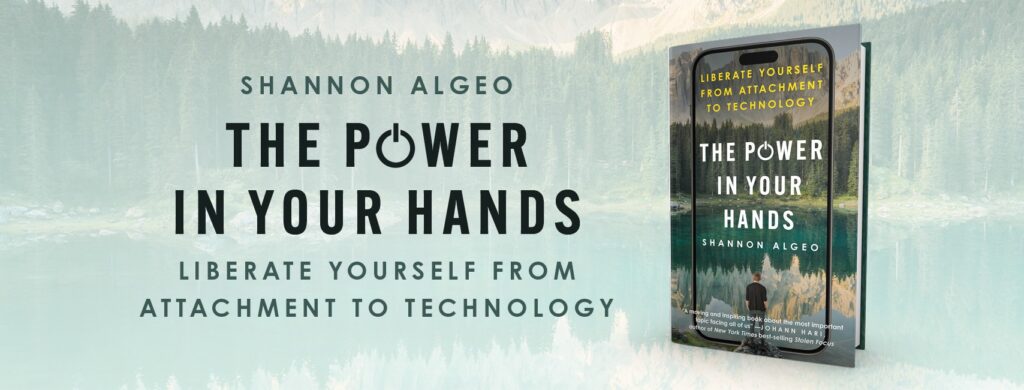
Shannon Algeo (he/him), MA, AMFT, APCC, is a psychotherapist, public speaker, meditation teacher, author of Trust Your Truth, and an alum of Pacifica’s Masters in Counseling Psychology program. Shannon’s recent book, The Power in Your Hands: Liberate Yourself From Attachment to Technology is “both an urgent wake-up call and a compassionate roadmap” about society’s attachment to technology and how to reclaim one’s life.
Pacifica: Congratulations on your book The Power in Your Hands. What inspired you to explore the relationship between technology, attachment, and the psyche in such a personal and in-depth way?
Shannon: As many Pacifica students and faculty know, graduate school presents seemingly infinite opportunities for self-reflection and deeper inquiry into the nature of the personal and collective psyche. When learning about attachment theory in graduate school coursework in the M.A. Counseling Psychology program, I kept having a loud and persistent thought, “I feel like I am in an attachment relationship with my smartphone!” I resonated with having an anxious attachment style, and I noticed the ways in which my anxiety would express itself through preoccupation on my phone; I’d manage my self-image on social media. I’d over-explain something I was feeling via text message. I’d check my phone again and again (and again) to see if he/she/they responded.
I began to shape my thesis research question around this curiosity and wondering. I dove deeper into the existing attachment research, which shows a strong correlation between insecure attachment styles with compulsive or problematic smartphone use. The affirmation of the research nudged me to keep exploring this topic and asking questions about how technology is acting as a “surrogate attachment figure,” as smartphones and LLMs increasingly replace real human interaction. For me, I began to feel a sacred grief for the “un-lived life” I could be living. “What is happening to my soul?” I wondered. “Doesn’t the soul need space to express and feel to fully realize itself?” “How can psyche be explored when there is no space for solitude? Or for the richness of long-form human interaction?”
Pacifica: In your message, you describe technology as affecting creativity, relationships, and connection to self. What did you begin to notice in your own life that made this inquiry feel so important?
Shannon: When I began reflecting on my own relationship to technology and my smartphone, I started to see how the amount of time I was spending tethered to my screen was precious time that I could be engaging in my real life and the natural, built world. The Power in Your Hands was born from this hope that I could be doing something else with my hands, my time, my presence, and my life force. Instead of wallowing in the dread of realizing how much time I had wasted away online, I became motivated to engage in meaningful creative process that could act as a “gravitational pull” to magnetize me into a worthy creative endeavor and away from my phone. Every moment spent ingesting and consuming content online could be a moment of mindfulness, presence, and creative inspiration.
Zen Buddhist teachings speak of “building a mind you can trust,” and I realized how the more I reach for my phone to direct my attention, the more lost I feel. Powerless and void agency and authorship over my life. I learned that if I want to become a steward of my attention, I must see—with fierce sobriety and gentle compassion—the ways in which devices seek to exploit my attentional agency and the ways in which my own daily habits are complicit such exploitation.
Pacifica: Your work brings together attachment research, poetry therapy, and depth psychological reflection. How did these different approaches come together in the writing of this book?
Shannon: I was really torn up about choosing my thesis topic. I had two topics I really wanted to explore, and they were quite different. One day I went on a 40-minute walk in Topanga Canyon without my phone to a nearby cafe I would frequent while in graduate school. I sat down at the cafe with my decaf Americano, and then my hand reflexively and compulsively reached for my right pocket to take out my phone. Alas, I remembered my phone was not there. I felt a wave of grief come over me as I reached for my pen instead. Out flowed a poem, titled Reaching for the Phone I Left at Home on Purpose. This poem is published in my final thesis, and it is the opening poem of The Power in Your Hands; it is the very first things readers see when they begin the journey through the book. Poetry therapy became an essential medicine for my practice of becoming aware of not just my physical addiction to my phone—but my emotional attachment as well. I learned in our substance use courses about the field of poetry therapy, a modality that is often used in substance use treatment centers to encourage access to deeper emotions in a safe and contained way that is non-shaming and relationship-building. When I did thirty days with a flip phone (no smartphone) as a part of my thesis experiment, I wrote poems beginning, during, and after my smartphone fast, as a way to facilitate the expression of my deeper underlying emotions and anxieties, to regulate my nervous system, to validate my experience, and to evoke soulfulness. Poetry therapy continues to be a medicine that helps me to see myself and technology’s impact on my wild and precious life.
Pacifica: One of the most striking ideas in your message is the question, “Who could I become without this weapon of mass distraction?” How did that question transform you personally?
Shannon: This is one of the lines that came through in the opening poem Reaching for the Phone I Left at Home on Purpose! I continue to sit with this question and ask it of others. For me, this question opens a portal to another dimension of being alive. It feels like a breath of fresh air, and at the same time, it acts as a reminder that I am accountable to the person I am becoming. In an article he wrote on attention, James William (2018) asks, “What do you pay when you pay attention?” He goes on to answer, “You pay with all the things you could have attended to, but didn’t: all the goals you didn’t pursue, all the actions you didn’t take, and all the possible yous you could have been, had you attended to those other things. Attention is paid in possible futures forgone.” My hope and intention in my book The Power in Your Hands is that readers, both clinicians and clients alike, are reminded of the power of their stewardship of their attention and presence. Now more than ever, we must become good stewards of our goals, intentions, values, and soul.
Pacifica: You write about compulsive smartphone use with compassion rather than shame. Why is that shift in perspective so important for both clinicians and the people they support?
Shannon: This is essential to getting free. I have found that compassion and grace are essential allies to walk closely alongside me as I hold myself accountable for any of my compulsive behaviors. Research clearly shows shame exacerbates addictive behaviors rather than addressing and tending to the deeper conditions which are causing it. It can be easy and tempting in our field to pathologize people’s behavior without a) understanding (with compassion) the underlying attachment-related needs that drive the compulsive behavior and b) contextualizing this problem as a societal addiction. According to Dr. David Greenfield’s “Smartphone Compulsion Test,” most individuals who own a smartphone would meet the criteria for having a problematic or compulsive use pattern. We are swimming in the collective unconscious of digitized society. I believe we must engage in practices of rehumanization and remember our human intelligence (HI) if we want to make real, meaningful changes in our relationship to technology. Focusing not just on what we are addicted to, but what we are moving toward is important to motivate ourselves and our clients toward change.
Pacifica: What do you hope clinicians, counselors, and helping professionals take away from The Power in Your Hands in their own lives and in their work with clients.
Shannon: I hope clinicians, counselors, and helping professionals who read The Power in Your Hands understand that small changes can lead to big shifts in awareness and embodied experience. This book’s greatest strength is not in the answers it provides (it is not a “tell you what to do” book), but in the questions it asks and the ideas and research it presents. I hope people who read this book feel inspired to try something new and play around with some offline experiments.
And in regard to our work with clients, I would say this: From my experience as a psychotherapist, I know I can be of highest service to others when I am attending to the shadow of my own technological relationship. How is technology impacting my nervous system? How is my body feeling while spending extended periods of time tethered to the screen? What is my attachment relationship to my device? What self-regulating resources am I truly attempting to reach for when I reach for my phone? And what does it feel like to move from digitization to rehumanization in my own life, body, and experience? When was the last time I did a digital fast, and how can I support clients to co-regulate and self-regulate from the ground of my own experience? We do not need to be “perfect” or “healed” to help others, and addressing this issue will likely messy and non-linear. May we embrace the process and learn through experimentation, trial and error, and through working together and talking about what is working well and what is continuing to challenge us. We must do this work of digital liberation together, side-by-side, in community.
~***~
To order The Power in Your Hands: Liberate Yourself From Attachment to Technology and keep updated with Shannon Algeo, please visit here. To learn more about the MA Counseling Psychology program at Pacifica, please visit here.

Shannon Algeo (he/him), MA, AMFT, APCC, is a psychotherapist, public speaker, author of Trust Your Truth, and meditation teacher. He is known by millions of people around the world for sharing his life experiences in ways that land in the hearts, minds, and bodies of individuals who are seeking to learn, grow, deepen, and heal.
His popular podcast SoulFeed features interviews with iconic cultural and spiritual leaders like Deepak Chopra, Marianne Williamson, Sonya Renee Taylor, the first Ugandan Nobel Peace Prize Nominee Victor Ochen, the first deafblind person to graduate from Harvard Law School Haben Girma, and more.
As a therapist, Shannon works with clients to heal patterns of trauma so they can show up in the world with power, presence, and purpose. He received his M.A. in Counseling Psychology from Pacifica Graduate Institute and is now pursuing licensure in the fields of Marriage and Family Therapy and Professional Clinical Counseling.