
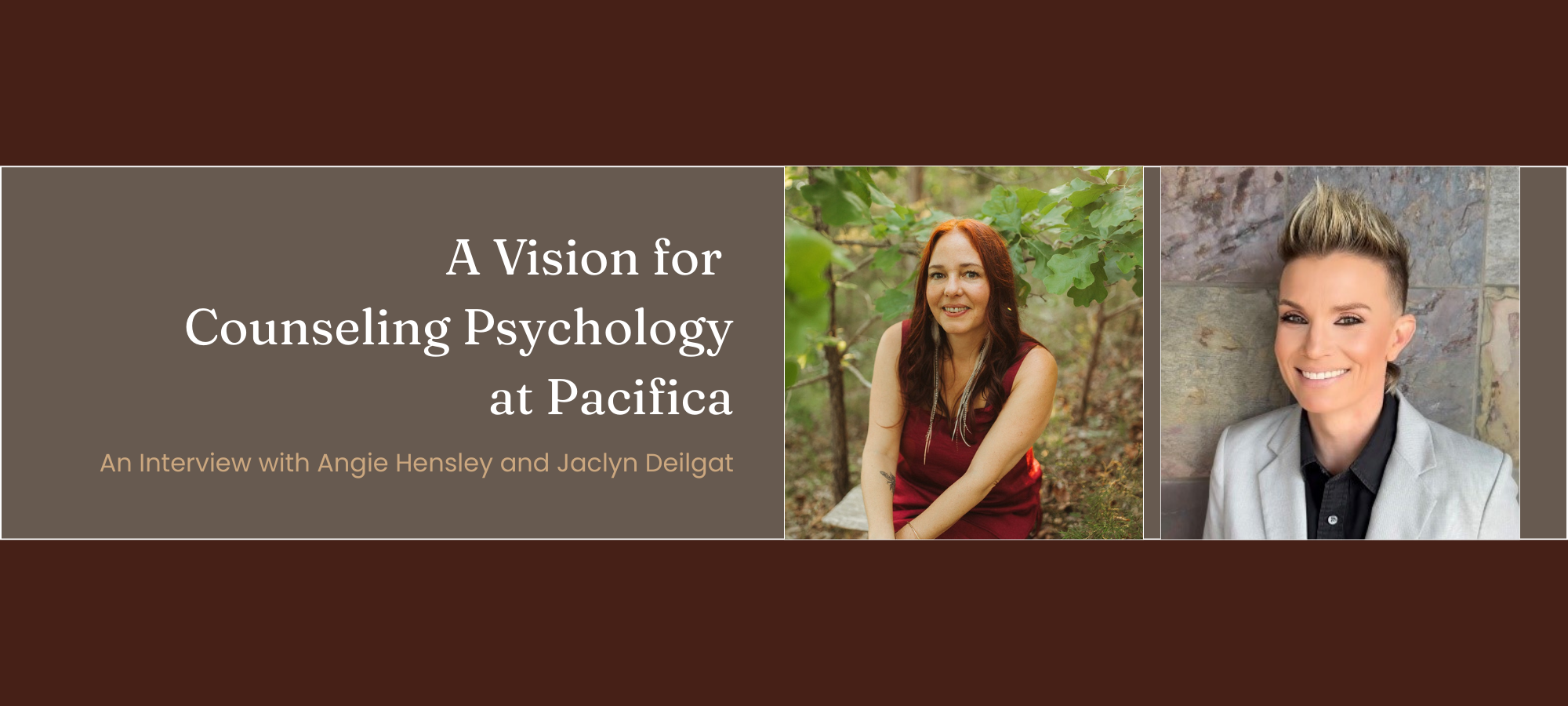
An Interview with Angie Hensley, Ph.D., and Jaclyn Deilgat, Ph.D.
Angie Hensley, Ph.D., is and Jaclyn Deilgat, Ph.D., are the new Co-Chairs of the counseling psychology department, which encompasses the Masters in Counseling Psychology program and the Psy.D. in Counseling Psychology with Emphasis in Depth Psychology program. I’m delighted to speak with them about their work and the future of the programs.
Angela Wood: Thank you both so much for speaking with me, and congratulations on your new roles in the psychology department. Please tell us a little about your background and the path that led you to teaching at Pacifica.
Angie Hensley: Thank you, Angela. I began my career in women’s health at Planned Parenthood. I spent time working in an abortion clinic, as a sex educator, teen mom group facilitator, and clinical supervisor. I have been the clinical director of the transformational recovery program at Shakti Rising, a grassroots nonprofit, taught at Folsom Lake College, California State University, Chico, and Maryville College. My educational journey began at City College and culminated at the California Institute of Integral Studies, where I earned a master’s degree in counseling psychology and a PhD in Human Sexuality. Currently my work centers on supporting clinicians and other helping professionals as we tend to the collective suffering occurring on the planet at this time. Psychotherapists have such a huge job right now, and we all need to uplevel the knowledge, skills, and capacities to show up for our big work in the world. I felt a soul calling to step in to help lead the Counseling Psychology department at Pacifica. The institute’s mission is in alignment with my personal values.
Jaclyn Deilgat: Thank you so much for the congratulating on the new role in the department. What led me to teaching at Pacifica started at a young age where I began tutoring my peers in fourth grade. I realized that students who were struggling in class started to succeed when they had extra time dedicated to their learning and that they needed information conveyed in a way that made sense to them. Throughout my K-12 schooling, I tutored a lot of students in different subjects and was also a notetaker for students who had ADA accommodations when I was in undergraduate studies at UCSB. I think this solidified my belief system that students could excel in courses if the right type of scaffolding was in place. Also, looking back at my school age years, my teachers were some of the most influential and inspiring people to me and in many respects I think they helped provide a felt sense of good enough attachment and have had a lasting imprint on my psyche. Obtaining my doctorate was incentivized by my desire to become a better practitioner and to enhance the likelihood of being able to teach future clinicians. A year after I graduated from the PhD in Clinical Psychology at Pacifica, I started adjunct teaching at Alliant International University, Reiss-Davis Graduate School, Antioch University, and Pacifica. After 5 years of adjunct teaching at these different educational facilities, I interviewed for a position as the director of research in Pacifica’s Counseling PsyD program which evolved into a core faculty position, which was a longtime dream come true. I have always been a blend of practitioner and scholar/researcher so the work I get to do at Pacifica is the perfect balance to what I do clinically.
Angela: What vision do you both hold for the Masters in Counseling Psychology program and the Psy.D. in Counseling Psychology with Emphasis in Depth Psychology program Are there any particular aspects that you’re excited about?
Jaclyn: I really love this question and think it’s something that Angie and I have spent a good amount of our time together discussing and identifying what our visions are based upon the needs of our community. We have spent time carefully listening to staff, students, and faculty in our department to hear what they feel is needed at Pacifica. In considering all of this, first and foremost we recognize that we are in the process of training clinicians who will be tending to the souls of people who they encounter. This is something that is quite meaningful and also carries a significant degree of responsibility. I am quite excited about working with Angie to support all the lovely humans Pacifica attracts. Every time I am on either of the campuses, I am in wonder and awe of the people who are in this shared space. Angie and I participated in a really powerful ritual together when we were on campus this month where we asked what we wanted to invite into the space and the work we are doing. Some of the central themes that came up were that we wanted soulful community where there is liberation of all through restorative practices, self-reflexivity, active implementation of DEIB practices, integrity, unity, benevolence, mutual respect, empathy, justice, loyalty, eros, kindness, playfulness, humor, love, embodiment, coherence, wisdom, heart, soul, and most importantly, safety. There is a need to recognize the ways in which the field of counseling psychology has perpetuated marginalization and intentionally move towards efforts to decolonize psychotherapy and educational practices.
Angie: It has been so fun to work with Jaclyn and dream into the possibilities for the department. Our vision is to steward a soulful learning community grounded in principles of integrity, liberation, and interconnectedness. We want to hold academic rigor alongside beauty and imagination, to support the department in becoming a recognized leader in depth psychology and depth related research. We are holding monthly dream tending circles with the students in a space called ‘Dream Lab’ that actually came from a dream I had right before my first day here. We want to apply everything we know about what brings soul forward in community. Dream work being one part of that.
Angela: What do you find to be unique and meaningful about Pacifica and the study of depth psychology? People who attend often say they feel it’s a home and a sanctuary, which is certainly not how everyone feels about their alma mater elsewhere!
Jaclyn: The first thought that comes to mind about what I find unique and meaningful about Pacifica and depth psychology is everything-the anima mundi. To get more specific, the way in which tending to the soul is at the core of depth psychology. I think of self-realization and the integration of all aspects of the individual is at the heart and soul of the work that we are doing. Presently, I think that we need to move towards placing society on the therapeutic couch and identifying the ways in which marginalized populations have been forced to suppress and repress who they are to fit into regressive, oppressive, colonial societal structures. In modern, Western psychological practices, with a shadow in colonialism, racism, discrimination, marginalization, oppression, and all types of isms, there is a strong need to examine the collective shadow of modern psychology and move towards a more liberated and socially just practice of psychology to truly tend to the souls of the world. I think Pacifica feels like home and sanctuary to a good amount of people and am eager to find a way to make it feel more like a sanctuary to all. I think there is some work that needs to be done to get there, and I find it inspiring, challenging, and something worth putting in the work to do it. I feel as though we are at a pivotal moment in time at Pacifica where we can move in a direction with other leaders in different programs and departments at Pacifica to have a collective movement towards restorative practices in our education offered here that will increase the felt sense of safety, and perhaps, in time, like Pacifica is a sanctuary for all. It is time that we examine the collective shadow and implement necessary reparations for the collective wounding that has occurred, globally, systemically, and in particular, in-depth philosophy, psychology, pedagogy and practice.
Angela: Who is the Masters in Counseling Psychology program a good fit for and how would you characterize the students in the program as a whole?
Angie: This program attracts students interested in Depth Psychology, transformative learning, and personal reflexivity. We tend to draw interdisciplinary learners who are scholarly and academically serious, and at the same time drawn to the imaginal. This is a space for community-oriented learners, as our program is delivered in a cohort model. Our students tend to be forward-thinking, ingenuitive, and have heart.
Angela: Jaclyn, you serve as the Director of Research in the Counseling PsyD program at Pacifica. In this capacity how do you work with students and can you give us a sense of the breadth and depth of the kind of work our students are doing in their research?
Jaclyn: Working with students in the dissertation process within the research sector is probably one of my favorite things I get to do at Pacifica. I really enjoy seeing the brilliant ideas our students have and assisting them in developing their ideas into what ultimately becomes a published work and a significant contribution to the field of counseling psychology, with an emphasis in depth. In recent years, a good amount of this focus has been on identifying ways to have methodologies that are more inclusive of marginalized populations given that main methodologies for examining human experiences in psychology are largely influenced by European and patriarchal belief systems. I’ve often found that the dissertation process is something that is intimidating to many and getting to sit with students in the first course that begins to build their finalized dissertation has been rewarding and inspiring. There are so many powerful dissertations that have been published, and others in the works, that it feels a bit limiting not to share what everyone has been working on. For a quick preview, here are some of the topics that students have recently investigated, or are in the process of investigating:
-
Traumatic limb loss from a Gestalt therapy lens
-
Religious cult defense mechanisms through object relations theoretical framework
-
The rape of Persephone: an alchemical hermeneutic exploration of trauma and integration of schizoid psyche
-
Decolonizing therapeutic practices to better meet the needs of the Filipino American diaspora
-
Development of more effective interventions to support Iranian American immigrants
-
Decolonizing behavior analytic theory and intervention: utilizing depth psychology, a critical analysis
-
Examining how Eurocentric educational practices in mental health programs exclude marginalized populations from gaining access to the field
-
Fostering a sense of belonging within the therapeutic relationship with bi+ identified patients
-
Invoking the soul of psychology: the use of neoplatonic ritual philosophy
-
Treating veterans with PTSD from a depth psychological approach
-
Healing through the expressive arts: acting and the treatment of trauma
-
The ecology of grief
-
Secret suicidality: why suicidal people do not tell
-
Applying Koan as a depth psychological approach in clinical practice
-
Michelangelo’s the four prisoners: an autoethnographic and alchemical hermeneutic analysis
-
Therapeutic potential of TTRPGs for autistic women
Angela: Angie, when you are not teaching at Pacifica or in practice as a psychotherapist, you run Terre Madre Retreat in Tennessee, where you “facilitate women’s ceremonies and rituals for personal, collective and planetary transformation & healing.” Please tell us about the founding of the retreat and your approach to facilitating ceremony.
Angie: Terre Madre was founded with the intention of being a sacred space for people to develop a relationship with their body wisdom, dreams, one another, and the land. I have a deep belief that the only way we are going to turn things around at this time in our history is through soul, and that is what the space at Terre Madre is all about. We practice becoming fluent in Psyche’s language through embodied dream work, ritual, expressive arts, and connection with the land. My approach to facilitating ceremony is rooted in teachings passed down from spiritual mentors. It involves calling in, setting, and tending to a morphogenetic field that heals and transforms. Local women gather monthly on the full moon and once a season. In this way, we are following nature’s wisdom, containing personal and collective work within cycles of the moon and seasonal medicine.
Angela: Jaclyn, you work as a license psychologist in San Diego, and provide services “to people who have severe psychiatric illness and substance use disorders in jails, psychiatric hospitals, and community mental health facilities.” How has depth psychology informed your clinical practice in challenging settings like jails and psychiatric hospitals?
Jaclyn: As I think about my work in psychiatric facilities and correctional facilities, other than people living on the streets, I cannot think of places in society with an ever more urgent and dire need for depth psychotherapeutic practices and soul tending. In these settings, I have seen the deepest soul suffering and unconscious forces that manifest as psychotic symptoms, deeply embedded defense mechanisms, extreme substance use, severely ruptured object relations, and maladaptive personality/character organization, all of which have a tense duality of protection and annihilation, of self and/or others. The collective shadow is quite active in these places with histories built on slavery, exploitation, eugenics, discrimination, marginalization, stigmatization, colonialism, and segregation. In these spaces I have found that patients and incarcerated persons have a significant need for depth psychotherapeutic intervention, as do many of the people who purported to protect, serve, and treat these individuals. Depth is both lively and deceased in these settings. While some of the early founders of depth practices commented on the manner with which dreams are the road to the unconscious, my experience has shown that active psychosis, pronounced defense mechanisms, severe addictions, volatile romantic relations, impaired ability to effectively relate, and be in relation, to others, and egregious behaviors are the highway to the unconscious. Depth has not only informed, but is embodied in how I show up in these spaces. I have seen that significant healing can occur when one shows up in a safe, empathic, and understanding fashion with an open mind and a curiosity to learn about what happened to people rather than trying to discover what is wrong with them. Further, I feel as though in accordance with some of the early analytic recommendations, that society should also be examined on the analytic couch if you will. These settings really make evident the need to examine the social influences that result in us displacing our fellow humans in settings that have an iatrogenic influence, or what Chen (2016) referred to as “iatrogenic trauma.” Places designed to rehabilitate and recover are filled with practices that isolate, marginalize, discriminate, stigmatize, and further oppress; the collective shadow needs tending in these spaces and depth practices are the pathway to healing. A number of quotes come to mind that people have shared with me in these settings, that will forever sit with me, influence my practice, and compel me to continue advocate for the need for depth, compassionate practices with these populations. One patient said, “when the virtuous stop fighting the good fight, evil wins and all hope is lost.” Another shared, “they keep giving me the crap end of the stick and asking me why I stink.” People who find themselves in these places often have a lifelong experience of traumatization, oppression, discrimination, ruptured attachment, abuse, societal alienation, and deep soul suffering. I think it is time that the virtuous show up so hope is not lost, and that we find ways to hand the crap end of the stick back to the oppressive societal forces and consider that maladjustment to a disordered society may be the most sane response.
Angela: Thank you both so much for your thoughts and time. I look forward to seeing the Counseling Psychology program continue to grow under your direction.
~***~
Angie Hensley is a licensed marriage and family therapist in California and Tennessee. She lives on the original homelands of the ᏣᎳᎫᏪᏘᏱ Tsalaguwetiyi (Cherokee, East) people, where she stewards 20 acres of land and hosts circles, workshops, and retreats. She believes in the power of circle-based, participatory, and empowered learning spaces. She facilitates deep academic inquiry that engages bodily knowing, heart, the natural world, expressive arts, dreams, and ritual. As a depth-oriented, somatic, and nature-based psychotherapist, she is interested in embodied research and using the felt sense in research methodology.
Jaclyn Deilgat is an Assistant Professor in the Counseling Psychology department, and is currently serving as the Director of Research in the Counseling PsyD program. She is a licensed psychologist who practices in San Diego, California. Jaclyn supervises Registered Psychological Associates who are registered with the CA Board of Psychology. She has dedicated a good portion of her clinical work to providing services to people who have severe psychiatric illness and substance use disorders in jails, psychiatric hospitals, and community mental health facilities. Jaclyn has been in private practice since being licensed in 2015 and provides affirmative therapy to the LGBTQAI2+ population and is active in her community for issues related to human rights. She is a strong advocate for restorative practices, DEIB, and destigmatizing psychiatric illness. Formerly, Jaclyn was a sub-investigator for clinical research trials examining the efficacy of novel medications to treat acute psychiatric illness.

Angela Wood is a contributing writer for Pacifica Graduate Institute, as well as the editor of the Santa Barbara Literary Journal. Her work has been published in Food & Home, Peregrine, Hurricanes & Swan Songs, Delirium Corridor, Still Arts Quarterly, Danse Macabre, and is forthcoming in The Tertiary Lodger and Running Wild Anthology of Stories, Vol. 5.