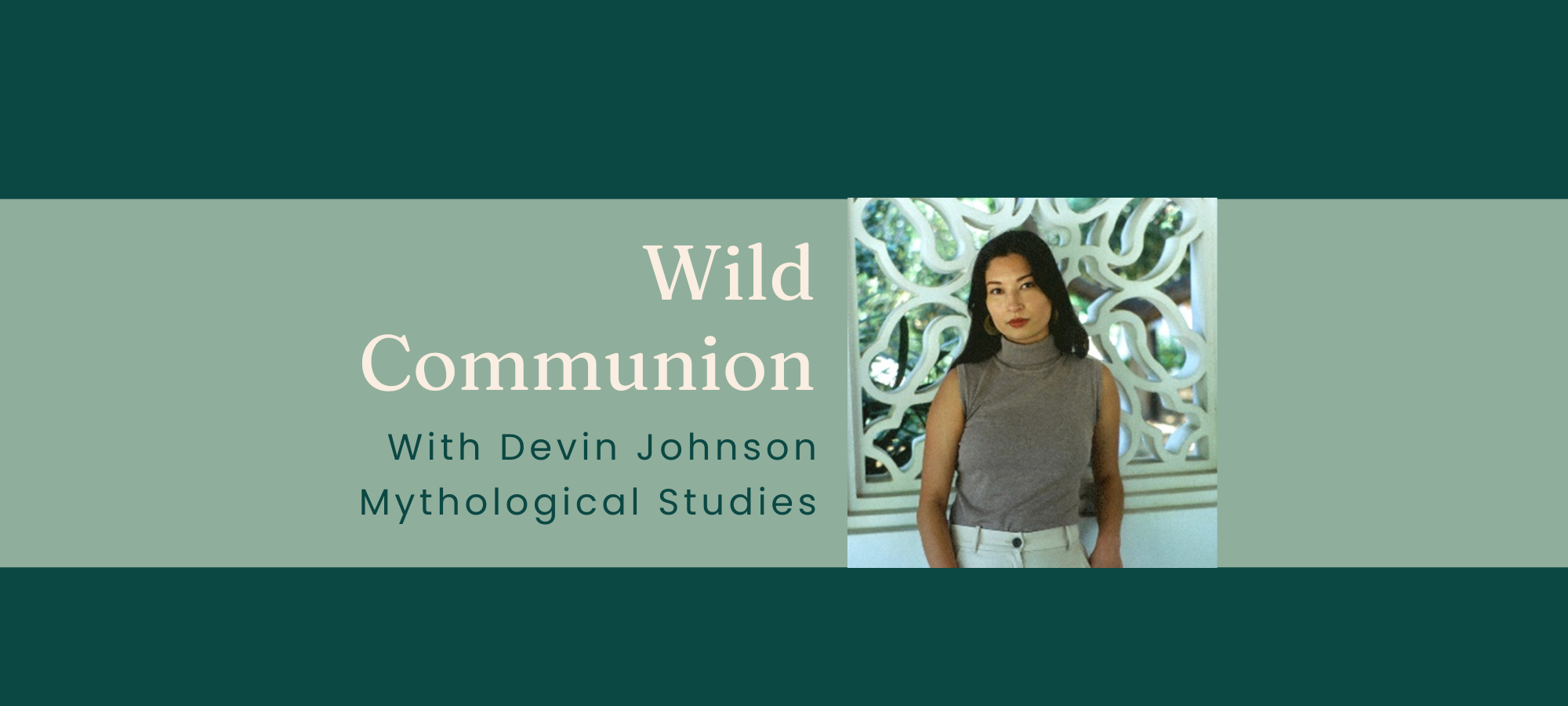
Devin Johnson is a third-year student in our M.A./Ph.D. in Mythological Studies with Emphasis in Depth Psychology program, who recently presented at the “Numinous Earth: Ecopsychology at the Edge” Conference organized by the California Institute of Integral Studies. The conference was put together in response to the “mounting polycrisis of our time-a cascade of deleterious impacts that endanger the viability of many life forms and whose disastrous trajectory seems on the rise-calls for creative reformulations of the role and meaning of the human amidst Earth’s web,” seeking to illuminate the ways that the numinous might deepen our understanding of the the paradigm shift in world view needed from the perspective of Ecopsychology. Devin participated in the “Wild Cosmologies & Ecopsychology at the Edge” panel.
Devin’s paper, “On The Wild Communion of the Blessed Earth Body: Towards a Poetics of Cosmological Reconciliation and Eco-Mystical Solidarity,” reflects a richness of scholarship and lived experience:
Colonial Catholicism has historically positioned itself as opposed to and superior to Indigenous cosmologies, often seeking to supplant Earth-centered ways of life through conquest, displacement, and forced conversion. Yet, the unfolding ecological crisis has compelled the Church to reconsider its relationship with Indigenous peoples worldwide—and even to reassess its own theological framework regarding humanity’s place within nature. In the 2015 encyclical Laudato Si’, Pope Francis calls for a global ecological conversion, urging the faithful to move beyond an “inadequate presentation of Christian anthropology”—one that has distorted humanity’s God-ordained role as Earth stewards into an anthropocentric dominion, driven by an unchecked “Promethean vision of mastery” over nature (par. 116). Instead, he advocates for an integral ecology that cultivates a sense of kinship and interconnectedness with all of creation. This paper will explore the evolution of Catholic eco-mysticism through a comparative theological lens, highlighting its convergence with Indigenous cosmologies and their shared vision for ecological healing and justice. Beyond theological discourse, I will also explore poetry’s role in shaping an evocative language that serves to attune the human psyche to nature’s numinous beauty and wonders. In my own creative practice, I seek to reconcile my Catholic faith with my Indigenous self, weaving together a poetics of Wild Communion—a vision of the Blessed Earth as a Beloved, yearning for a union with humanity that is both sacred and sensuous. In a call for intercultural and inter-cosmological solidarity, I urge the world’s eco-mystics to unite in guiding our wayward hearts back home—back into deep communion with our shared refuge: Our Lady, Mother Earth.
Angela Wood: “Wild Communion” has the resonance of a mystic and a poet. What does Wild Communion mean to you and how does it reflect both your personal process and your academic work?
Devin Johnson: It’s a term I borrowed from Jungian analyst Clarissa Pinkola Estés in Women Who Run With the Wolves, where she retells the story of “The Handless Maiden.” In the tale, the young heroine moves through individuation by enduring a series of initiatory trials in the “Underground Forest.” At one point, exhausted from her perilous journey, she encounters a pear tree that bends down to feed her, nourishing and enlivening her with its fruit. Estés writes that the tree “gives her a taste of the Self, the breath and the substance of her own wild God, a wild communion” (304).
This primordial image has followed me throughout my studies of Earth-centered and Indigenous cosmologies: the convergence of consciousness between woman-and-tree. In my talk, I shared a memory from my childhood on the Pacific island of Guåhan, where I would regularly commune with the spirits of the banyan tree outside my school during recess. At that same school, inside the chapel, I practiced the Christian concept of communion with God through bread and wine. The phrase “Wild Communion” resonates with me because it poetically re-centers the fruits of the Earth as the prima materia through which we mystically converge with God, or with the Self. Without the blessed fruit of our Earth Mother’s womb, our souls remain estranged from a vital sense of intimacy and belonging with the greater living world and cosmos.
Angela: You mentioned a term I hadn’t heard before, “eco-mystics” and I wondered if you would speak a little about what being an eco-mystic means to you, and why this approach to our Earth’s and our own well-being is so important now.
Devin: If a mystic is traditionally understood as someone who attains union with God, the Self, the Deity, or the Absolute through spiritual surrender, then an eco-mystic is someone who recognizes that such union cannot be realized without the humility required to form right relationship with the Earth and all our living kin, human and more-than-human alike.
I believe much of the strife and suffering we experience as a species stems not only from a sense of spiritual exile from a heavenly God, but also from an ecological exile from our own terrestrial home. The peace and unity we long for cannot be reached through an abstracted notion of God alone, but through a grounded communion with the Earth as well. She is our shared home, our shared refuge. When we begin to recognize her as such, and remember ourselves as her children, we can reinhabit our place in the world with purpose and harmony, becoming loving stewards rather than destructive conquerors of land and neighbor.
To me, the role of the eco-mystic is to shepherd us toward this restored vision of home and belonging: one in which the sacred and the earthly are not separate realms, but two faces of the same divine reality.
Angela: What has your experience of the Mythological Studies program been like, and how has the study of myth impacted your work?
Devin: If my earlier academic experiences were oriented toward accumulating knowledge in order to build a secure and solid sense of Self and Truth, then the Mythological Studies program has completely undone that instinct. The study of myth has required me to cultivate a profound humility. Instead of grasping for certainty, I’ve had to allow larger, older, and often mysterious forces to guide me through uncertainty, complexity, and the vast unknown.
It has invited me into a deeper attunement with mystery itself, transforming not only how I think, but how I move through and relate to the world around and within me. Ultimately, I feel it has initiated me into my own nostos—a homecoming. This journey has brought me back to re-rooting myself in the ground beneath my feet and to Earth-centered ways of knowing and being, a wisdom my ancestors long practiced but from which I had, until very recently, felt profoundly distanced.
It is truly through the art of myth-making and storytelling that I have been able to build this bridge back home—and even back to my literal home island of Guåhan, where I am reconnecting with like-minded and like-hearted people in the realms of art, storytelling, spirituality, and religious life whose work resonates with the vision I am crafting for myself through the program. For that, I am truly grateful.
~***~
A video of the “Wild Cosmologies & Ecopsychology at the Edge” panel is available here.
For those interested in the M.A./Ph.D. in Mythological Studies with Emphasis in Depth Psychology program, you can learn more here.

Devin Nicole Johnson is a third-year student in Mythological Studies at Pacifica Graduate Institute, where she weaves myth, art, literature, religious studies, depth psychology, and feminist and decolonial thought into an evocative practice of mythopoeisis. Like all the world’s mystics, she seeks to realize greater peace and unity within the numinous whole of creation, using her voice to lure others ever closer towards the Truth of Love—in all its mystery and complexity.

Angela Wood is a writer for Pacifica Graduate Institute, as well as the editor of the Santa Barbara Literary Journal. Her work has been published in Food & Home, Peregrine, Hurricanes & Swan Songs, Delirium Corridor, Still Arts Quarterly, Danse Macabre, and is forthcoming in The Tertiary Lodger and Running Wild Anthology of Stories, Vol. 5.